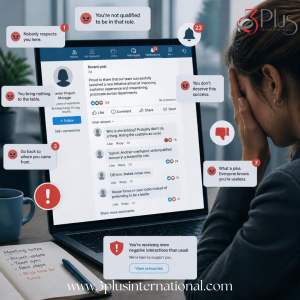
Objectifying women impacts their professional experience

Obviously, it is impossible for a man to answer that question with any accuracy, since he is … well … a man. But I’ve spent the last 20 years working with men – mostly white and straight – to get them to walk around for a little while in a woman’s shoes. And let me tell you, most men’s feet do not fit well into high heels – not at first anyway.
My partner Bill Proudman and I co-founded White Men As Full Diversity Partners (WMFDP) with another colleague to bring about a paradigm shift in workforce equality across the gamut of corporate America. The hard truth is that most of our CEO and executive structure is white and male. There are five black CEOs and 23 female CEOs on the Fortune 500 list for 2015. That alone should give one an idea of the obstacles faced by women, people of colour, and LGBT employees.
Read: Bill Proudman… Trump, Sexism and the Alt-Right
But who has been left out of the diversity conversation?
White male corporate leadership. And as the Bard would tell us, “Ay, there’s the rub,” i.e. there’s a serious problem here. So we formed WMFDP to tackle the issue. With a company name that gets people talking, I set out on my life’s work.
I recently wrote a book, Four Days to Change, chronicling the many insightful experiences I have had mentoring leadership and employees across the spectrum of American business.
Chapter 16 of my book is pointedly called Objectifying Women. In it, I offer up live examples from our “caucuses” (learning labs) wherein I challenge our white male participants to acknowledge how they have been doing just that (objectifying women) often unknowingly. I ask men to stand up if they’ve discussed a female associate’s body with other men, if they’ve viewed pornography, if they’ve been fixated on a part of a co-worker’s body – on down the list, 21 different questions.

By doing this, some men start to step outside their systemic and ingrained bias. But that is just the beginning, and the more dialogue and debate, the better.
Read: The growing public disrespect of women
By the end of several days, we start to see tangible change. A few men have come up to me and confessed that sometimes when they are speaking to a woman, they’re looking at her chest, or they’ve always thought a man could do a job better than a woman, but they’ve never had any basis in reality for that assumption.
And if I’ve done my job, I have new partners in cultivating an atmosphere of fairness and inclusion. That is my mission.
In another section of my book, I delineate what I describe as the Fourteen Examples of Male Privilege. Some of the points on the list include:
- I can walk the streets without being the object of gawks, whistles, catcalls, harassment, or attacks because of my gender.
- I don’t worry about the threat of rape or sexual violence due to my gender. It is not an undercurrent that impedes my moving freely.
- My ability to function effectively during a crisis is not questioned because of my gender.
- I do not experience being patronized because of my gender.
That last one is important. Women want to be treated as an equal, no more, no less. At the same time, there are very real issues regarding child-rearing, breastfeeding, and dynamics that are undeniably female. So we work with people to walk that line.
Women are equal. But women are women. You’d think it didn’t need to be stated. But it does. It most certainly does.
Originally posted on WMFDP