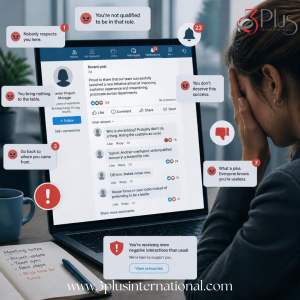
The Pretty Privilege
Although appearance bias affects men and women in the workplace, it tends to impact women more. Read more about The Pretty Privilege
Sunita Williams returned to Earth a few weeks ago after nine months at the International Space Station (ISS) – a huge achievement! While she was up there, she contributed to groundbreaking experiments, tackled technical challenges, complete with spacewalks.
Imagine on your return instead of accolades, there is global speculation about your physical appearance. Some of these articles are written by women. No mention of her male colleague – I don‘t even know his name without looking it up. In 1978, NASA engineers designed a makeup kit they thought female astronauts would need. Now, I know absolutely nothing about going to space. The thought of being somewhere up there in the ether for nine months fills me with horror. But I feel confident in guessing that the last thing I would be thinking about is my lippy and mascara.

So even after floating around in a state of weightlessness for three quarters or a year it seems looks matter. What is wrong with us?
The Pretty Privilege
Although appearance bias affects men and women in the workplace, it tends to impact women more. In a survey contacting 60,000 respondents with Elle Magazine and NMBC , 61% of women said they thought men judged them based on their looks, followed by work ethic (54% ) and accomplishments (49%). This happens at every stage of their careers, influencing how they are perceived, treated, and valued. From job applications to promotions and leadership roles, the way a woman looks can shape her opportunities and challenges in ways that often go unnoticed or unspoken.
Research indicates that physical attractiveness can significantly influence employment outcomes, with attractive individuals often experiencing advantages in hiring and promotion processes. These studies show that “both attractive men and women are often seen as more talented, kind, and intelligent and that can lead to promotions and raises,” says Gordon Patzer, author of Looks: Why They Matter More Than You Ever Imagined. Unattractive men, meanwhile, earned 15% less than their attractive coworkers in a London Guildhall University survey of 33-year-olds. Unattractive women earned 11%. Whatever attractive means.
But for some it can be a double-edged sword.
Good looks pays
Another study by the University of Southern California and Carnegie Mellon University tracked over 43,000 MBA graduates for 15 years, finding that those deemed attractive were 52.4% more likely to secure prestigious positions and earned approximately $2,500 more annually than their less attractive peers. For the top 10% in attractiveness, this salary advantage increased to over $5,500 per year. These benefits were more pronounced in client-facing roles, such as management and consulting, compared to technical fields like IT and engineering.
Another study involving 1,050 employed Americans revealed that individuals who rated themselves as extremely attractive reported earning nearly $20,000 more annually than those who considered themselves unattractive. This phenomenon, often referred to as “pretty privilege,” extends beyond financial benefits, encompassing preferential treatment in various social contexts.
The “what is beautiful is good” stereotype suggests that people often attribute positive qualities, such as intelligence and competence, to attractive individuals. This bias can lead to favourable treatment in professional settings.
Beauty Bias
The field of “pulchronomics,” which studies the economic impact of beauty, has demonstrated that attractiveness can affect earnings, career progression, and even longevity. Research by Daniel Hamermesh indicates that attractive individuals often earn more, with good-looking men experiencing an income boost comparable to five years’ worth of work experience by age 40.
These findings underscore the pervasive influence of physical appearance on professional opportunities and outcomes, highlighting a form of bias that continues to shape workplace dynamics.
Goldilocks Dilemma
But what is the right amount of good luck to have with the pretty privilege? Young-looking women report receiving feedback that they lack gravitas for a leadership role. Older women are judged harshly for grey hair and laughter lines and look as though they are past it.
When female recruiters assess female candidates, they can perceive attractiveness as a disadvantage for unspecified reasons. Jealousy? If a woman is “too good looking” whatever that is, that can also be held against her, and we default to the dumb blonde stereotype. But to quote Dolly Parton:
I’m not offended by all the dumb blonde jokes because I know I’m not dumb… and I also know that I’m not blonde.
We really need to get over all of this.