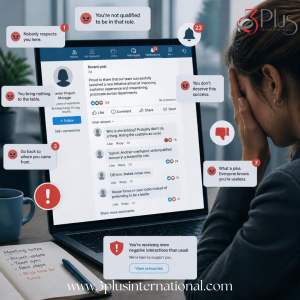
The Hidden Risk in Your Review Cycle
Many organisations haven’t fully understood that 360 feedback without unconscious bias training can do more harm than good. 360-degree performance reviews promise something appealing: a fuller picture of how employees actually show up at work, drawn from peers, direct reports, and managers alike. More voices should equal greater fairness, or so the thinking goes.
But here’s the reality and what too many organisations skip past is that the people giving that feedback usually haven’t been trained in unconscious bias and are not always making the process more inclusive – they are only scaling the effort.
The Problem With “More Perspectives”
Unconscious bias doesn’t disappear when you add more reviewers, it only multiplies. Each person rating a colleague brings their own set of deeply ingrained assumptions about what leadership looks like, what “professional” sounds like, who gets credit for ideas in meetings, and who gets blamed when things go wrong. Without training, those assumptions don’t get examined, but can get aggregated, averaged, and handed back to an employee as “feedback from the team.”
Frequently, for reasons of confidentiality, the reviewer is not able to disclose who said what and when a specific situation occurred. Frequently, this makes the feedback non-actionable.
Research consistently shows that women and people from ethnic minority backgrounds receive qualitatively different feedback in peer reviews, less specific, more focused on personality traits (“she can be abrasive”) and less on measurable outcomes (“he grew the account by 30%”). Ambiguity in feedback criteria is where bias thrives and 360 reviews, by their very nature, are full of ambiguity.

The Specific Dangers
1. Affinity bias reinforces in-groups. People tend to rate those who are similar to them, in terms of background, communication style, or social habits, more favourably. In a 360 process, this means staff who don’t socialise with the dominant group, who work remotely, or who come from different cultural norms around self-promotion can be systematically underrated by peers who simply don’t recognise their contributions.
2. Attribution bias punishes some and protects others. When a project succeeds, who gets the credit? When it fails, who gets the blame? Without training, reviewers unconsciously attribute success to effort and ability for people they identify with, and to luck or circumstances for those they don’t. A 360 review captures and formalises those attributions. Research indicates that women on mixed sex teams are more likely to be blamed (blame attribution) for project failure, particularly when only group-level feedback is available. This gender bias often stems from stereotypes that attribute women’s failures to lack of talent, rather than bad luck the option typically assigned to men.
3. Language in written feedback carries hidden penalties. Studies of performance reviews by Textio show stark patterns: words like “aggressive,” “difficult,” or “needs to communicate better” appear disproportionately in feedback about women and people of colour, even when the underlying behaviour is identical to that of white male colleagues described as “direct,” “decisive,” or “confident.” Untrained reviewers don’t notice they’re doing this and genuinely believe they’re being objective.
Worth a read: Actionable feedback – why language matters – 3Plus International
4. Likability masquerades as performance. Without clear behavioural anchors and bias training, peer reviews often measure how much someone is liked rather than how effectively they perform. Introverts, neurodivergent employees, and those who challenge groupthink can score poorly, not because they aren’t effective, but because they don’t fit the unspoken social template that reviewers have internalised.
5. The “prove it again” tax falls harder on some. For employees from underrepresented groups, 360 reviews can compound an already exhausting dynamic: having to demonstrate competence repeatedly, while majority-group colleagues are extended the benefit of the doubt. When peers without bias training evaluate, they may not consciously notice that they hold different people to different standards.
6. Culture Creep. You have seen me write about the Overton Window and how more extreme views found in our wider cultures are filtering into our workplaces. Research shows that in younger age groups men think steps towards gender equality has gone too far. How long before this is reflected in our hiring processes and feedback commentary, if it isn’t already.
What Happens When This Goes Wrong
The damage is concrete. Employees who receive biased feedback, even when well-intentioned or unconscious, may be passed over for promotion, excluded from development opportunities, or quietly managed out. The organisation loses talent it probably fought hard to recruit and the employee leaves with a distorted sense of their own capabilities, shaped by feedback that was never really about them.
Learn how to manage bias with our Unconscious Bias Training Workshops.
Worse, the organisation gets to feel good about having run a “fair, multi-source” process. The 360 format provides a sense of superficial objectivity that makes the bias harder to name and challenge.
What Good Looks Like
Bias training before a 360 cycle isn’t a nice-to-have but should be a prerequisite and as a minimum, reviewers should understand:
- What unconscious bias is and how it operates in performance contexts
- How to give behavioural, evidence-based feedback rather than impressionistic character assessments
- The difference between evaluating someone’s impact and evaluating their personality
- How to notice when their feedback might be shaped by affinity, attribution, or stereotype
Organisations should also build structural safeguards: calibrated rating scales, guidance on what good feedback looks like, review of submitted comments for language patterns before results are shared, and training for managers on how to interpret 360 data critically.
Training Should Be Mandatory
360 performance reviews can be a genuinely powerful tool for development and fairness, but only when the humans using them have done the work to examine their own assumptions. Without that groundwork, you’re not running a fairer process. You’re just distributing bias more efficiently.
If you’re planning a 360 cycle, ask yourself: have we invested as much in preparing our reviewers as we have in designing the process? If the answer is no, the kindest thing you can do is pause, train, and then proceed.
Your people deserve feedback that reflects their actual performance, not a mirror of everyone else’s blind spots.
Build and hold together inclusive teams with help from our specialist corporate services. Get in touch for a FREE Strategy Call